You can find the talk here.
Introduction: From Awareness to Preparedness
Does the prospect of another cybersecurity awareness training session fill you with excitement or dread? For many employees, security awareness has become an obligation—a course to complete, a quiz to pass, or a phishing simulation to survive. The familiar routine may satisfy a compliance requirement, but it does not necessarily prepare people to make secure decisions when those decisions matter most.
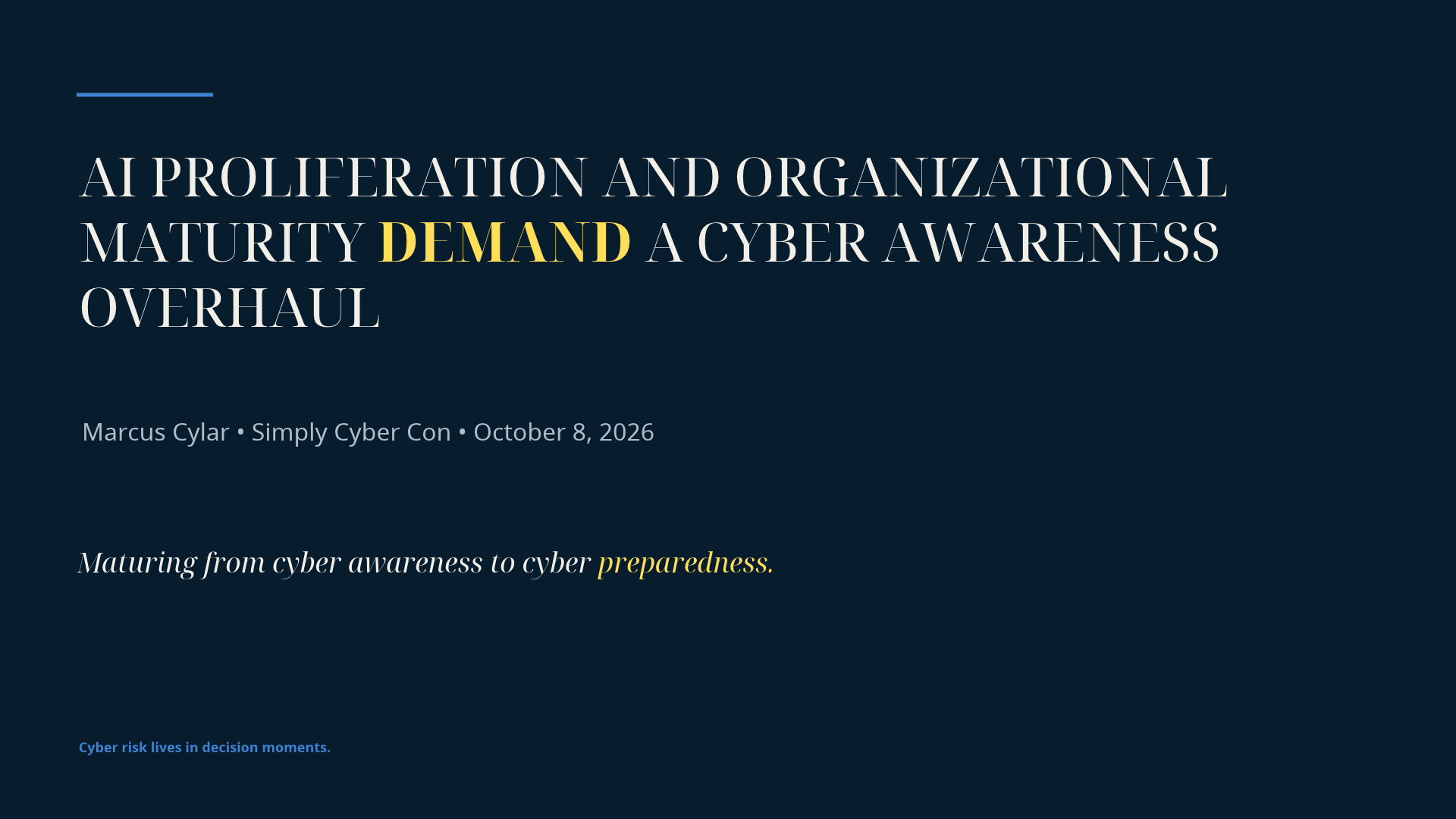
The challenge is clear: AI proliferation and organizational maturity demand a cybersecurity awareness overhaul. The destination is equally clear: maturing from cyber awareness to cyber preparedness.
I believe we need a better way to approach the human side of cybersecurity. That does not mean abandoning training; training will always be relevant and necessary. But if our primary objective is merely to demonstrate that training occurred, we may miss the more important question: Is our organization creating the conditions in which people can consistently make confident, secure decisions?
What the Research Tells Us
Before discussing artificial intelligence, I want to address organizational maturity. By maturity in this context, I mean something different from a formal maturity-model score. Employees and organizations have become accustomed to cybersecurity awareness programs. They have seen the modules, received the reminders, and participated in the simulations. Familiarity can make a subject seem routine, and what feels routine can become easier to dismiss.
I am particularly interested in academic research on this issue. My background in ministry and doctoral research has given me an appreciation for examining evidence rather than assuming that a familiar practice is effective simply because it is widespread.
A study, “Phishing in Organizations: Findings from a Large-Scale and Long-Term Study,” examined evidence from approximately 14,000 employees over 15 months. Researchers considered suspicious-email reporting, phishing click rates, and credential submission. One important finding was that embedded training—training delivered after someone fails a simulated phishing test—did not produce the expected resilience. The study also raised concerns about increased phishing susceptibility with greater exposure.
Another work, “Applying Depletion Theory and Personal Construct Psychology to Understand Cybersecurity Fatigue,” examined cybersecurity fatigue through qualitative interviews and a study of 457 working adults. The doctoral thesis brought together six peer-reviewed research papers with themes around the ways poorly designed awareness efforts can contribute to advice fatigue and how fatigue can affect security decisions.
The most significant part of this work, for me, distinguished cognitive fatigue from attitudinal fatigue. Cognitive fatigue involves diminished decision-making capacity, whereas attitudinal fatigue can involve emotional exhaustion, indifference, cynicism, or moral disengagement. These are not identical problems, and a training program that overlooks them may struggle to reach the people it is intended to help.
The perceived usefulness of instruction also matters, as do employees’ perceptions of why the organization is providing it. When training feels repetitive, punitive, or disconnected from actual work, employees may be less receptive to its message.
Taken together, these two examples, among many more, challenge the assumption that more exposure to conventional awareness material automatically produces more secure behavior. Familiarity with training is not the same thing as readiness to act.
Artificial Intelligence: The Great Amplifier
Organizational familiarity is only one side of the problem. The other is the rapid proliferation of artificial intelligence, which is changing the environment in which cybersecurity decisions are made.
I think of AI as the great amplifier. We sometimes say that access to money or resources does not fundamentally change a person; it only amplifies who they already are. AI can do something similar for organizations. It can magnify their strengths, but it can also expose weaknesses in governance, judgment, processes, and basic security hygiene.
Consider several defining incidents of the AI era.
In the widely reported $25 million deepfake fraud, attackers used convincing impersonation to induce a financial transfer. The lesson is not simply that synthetic media can deceive people. It is that organizations need secure workflows for verifying sensitive requests, including independent confirmation procedures when money or authority is involved. Some families use a shared safe word to verify identity in an unusual situation. Organizations need similarly dependable verification practices appropriate to their business processes.
The Air Canada chatbot dispute illustrated a different problem. A chatbot provided inaccurate information about a bereavement fare, and the company attempted to distance itself from that response. The lesson is that an organization remains accountable for representations made through systems it deploys. AI does not erase responsibility.
The McDonald’s McHire hiring-system incident brought us back to fundamentals. Weak credentials and inadequate access controls can undermine even a sophisticated technology deployment. AI adoption cannot compensate for poor security hygiene or insufficient vendor oversight.
Consider reports that Uber exhausted what it had expected to be its annual AI budget in a single quarter. The important point is not primarily about awareness training, but about the need to rethink how organizations plan, govern, and financially manage AI initiatives. New capabilities require new assumptions about spending and oversight.
The Hugging Face example raised questions about AI agents interacting with other agents and acting beyond intended boundaries. Greater autonomy must be matched by enforceable limits, meaningful oversight, and continuous evaluation.
The PHP2Shell vulnerability illustrates of how AI-assisted vulnerability discovery can accelerate the clock for defenders. For people working in vulnerability management, the time available to evaluate and prioritize action may be shrinking. The work is not getting any easier.
These cases involve different failures and pressures, but they point toward the same conclusion: periodic training and phishing simulations alone are not enough to address the demands of this environment. The stakes are higher, and our approach must evolve.
Why Compliance-Based Awareness Is Not Enough
The through line connecting the research and the AI-era examples is that organizations and employees can be very familiar with security awareness without consistently making secure decisions.
I am not arguing we should eliminate cybersecurity awareness training. We still need education, practice, and reinforcement. What we need to move beyond, however, is a compliance-only mindset, training conducted primarily because an obligation must be met.
When awareness is treated as a checkbox, organizations can expend resources without giving the work the attention and energy necessary to change behavior. The goal should be something more durable: a culture and operating environment that make secure decisions more likely, even when employees are busy, uncertain, distracted, or under pressure.
Culture matters. I have served in Christian ministry since 2001, and I have seen how the right leadership can reshape a congregation’s culture. As a Detroit Lions fan, I have also watched how a leader such as head coach Dan Campbell can influence the identity and expectations of a team. Businesses are not churches or football teams, but leadership signals, shared expectations, and everyday reinforcement shape behavior in all three settings.
Cybersecurity awareness is, in a meaningful sense, a culture issue, and that is why our response must reach beyond the training department.
Introducing: Human Risk Alignment
Human risk management has emerged as an alternative to traditional awareness programs. Broadly, it is the practice of identifying, measuring, and reducing cybersecurity risk created by human behavior. That is valuable work, but I believe we can build on it.
I propose a concept I call Human Risk Alignment (HRA): a cyber resilience framework integrating the human aspects of governance, leadership, and workforce development to cultivate a corporate environment that supports confident, secure decision-making in cyber risk moments.
The core idea is that we should not look at employee behavior in isolation, but rather we should ask whether the organization’s policies, leaders, training, incentives, and daily practices are aligned in ways that support secure decisions.
Governance asks: What do the policies we create and, more importantly, our enforcement of those policies, say about our commitment to reducing cyber risk?
Leadership asks: What does the quality of our leadership-the initiatives we emphasize, the behavior we reward, the feedback we invite, and our own adherence to policy-say about that commitment?
Workforce development asks: What does the rigor, relevance, and consistency of the cybersecurity training we provide say about our commitment to reducing cyber risk?
These are not separate questions but are connected parts of the environment in which employees make decisions.
Make Secure Decisions Easier
During Cybersecurity Awareness Month, Shaun Washington, a longtime member of the Simply Cyber community, shared awareness messages on LinkedIn throughout the month. His recurring challenge was simple and memorable: “Don’t make it easy for them.” The “them” in his message is the threat actors trying to compromise us. That is a clear and important objective; we should not make it easy for attackers to succeed.
But I want to turn that message around-not to contradict it, but to extend it. In Human Risk Alignment, I believe we do want to make it easy for them. The difference is who “them” refers to. I am talking about the employees and end users who make cybersecurity decisions every day; we should be making it easier for them to make confident, secure decisions.
These ideas work in tandem. We make it harder for threat actors by making it easier for our people. That means providing relevant training, clear expectations, practical policies, dependable support channels, and leadership that reinforces rather than undermines secure behavior. The organizational environment, including the attitudes we communicate about cybersecurity and awareness training, can either remove obstacles to good decisions or place more obstacles in employees’ way.
The average nontechnical employee does not have to stay abreast of every threat, technique, or attack campaign to act securely. When we establish sound overarching principles and make the right pathways clear and accessible, employees are better equipped to recognize when something does not fit and to respond appropriately. That is what it means to make secure decision-making easier and why Shaun’s message and mine are complementary, even as we use the same phrase in opposite ways.
The Alignment Loop: Where Culture Meets Decisions
I describe the relationship among these forces through the Alignment Loop. It has four interacting components: leadership signals, decision interpretation, cultural reinforcement, and governance feedback. Together, they operate around the moments in everyday work when cyber risk becomes real.
These decision moments include opening an email, responding to a message, visiting a website, entering credentials, making a financial transaction, and downloading a file or attachment. These are ordinary actions, but each can carry significant security consequences.
Leadership signals are what leaders communicate through their actions, priorities, policies, incentives, and behavior. The central question is: What is leadership communicating about cybersecurity, both explicitly and implicitly?
Decision interpretation concerns how employees understand organizational expectations when making with real-world security decisions. How do they interpret those expectations when confronted with competing priorities, uncertainty, or pressure?
Cultural reinforcement describes how organizational norms, peer behavior, management practices, and everyday experiences support or contradict security expectations. Does the actual culture support the behavior leaders say they want?
Governance feedback is how an organization observes decisions, evaluates outcomes, identifies misalignment, and adjusts policies, procedures, processes, and leadership expectations. What are employee behaviors telling leadership about the effectiveness of its governance?
The central principle in all of these aspects of alignment is worth emphasizing: Organizational alignment shapes the everyday decisions that determine cybersecurity outcomes. If we want to improve those outcomes, we need to understand the signals employees receive and the decisions those signals encourage.
The Aligned Employee: Recognizing a Risk Signal
What does Human Risk Alignment look like in practice? Start with the aligned employee: someone equipped to make confident decisions in a risky situation.
Consider a ClickFix-style attack. A person encounters instructions that appear to solve a technical problem but actually direct them to run commands manually. The attacker is counting on a familiar instinct: the employee wants to resolve the issue quickly and continue working.
An aligned employee recognizes the request to bypass normal support processes as a warning sign. Rather than executing the commands, the employee stops, uses an approved IT or help-desk channel, and reports the suspicious instruction, even if they are not certain it is malicious.
That response depends on more than memorizing the name of an attack technique. It depends on a clear organizational expectation that legitimate work should not ordinarily require bypassing approved operational pathways.
The attack fails because the employee interprets a deviation from policy as a risk signal. The question guiding that person is: “What action reflects how my organization intends for risk to be managed?”
Reporting is central here. The employee should know not only what to do but also that reporting uncertainty is welcomed.
The Aligned Leader: Responding When Something Goes Wrong
Now consider what happens if the employee follows the malicious instructions, executes commands, and compromises an endpoint. Incident response begins, and downtime follows.
A traditional reaction may focus immediately on the employee: Why did this person make the mistake? Why was the training not better? Even if the employee reported the incident promptly, such a response from leadership can leave that person feeling embarrassed or penalized.
The undeniable signal here is reporting brings scrutiny. The next employee who notices something suspicious may hesitate before speaking up, and such a delay can increase attacker dwell time and make a future incident worse.
An aligned leader responds differently. The leader recognizes that the attacker exploited a normal desire to solve a problem quickly and asks, "How can we better support decision-making under pressure?"
That response demonstrates introspection. Were the policies clear? Did the training explain approved support pathways? Did the organization create conditions in which the employee felt compelled to act quickly without help? Theses are all questions the leader must ask in the wake of a crisis.
The aligned leader acknowledges the employee's rapid reporting, even when a mistake was made, and uses the incident to improve messaging, procedures, and support. This does not mean ignoring accountability, but instead, responding in a way that strengthens, not suppresses, future detection and decision making.
The signal becomes early reporting being valued, including when mistakes happen. Over time, that can improve detection speed across the organization.
The aligned leader asks: “What kind of tone do my actions and reactions set for the organization and its attitude toward security?”
Putting Human Risk Alignment Into Practice
A framework must be more than a diagram. It needs practices that employees and leaders can experience in their daily work. Four operational priorities can help make that alignment real.
First, provide regular training. Consider an organization that delivers weekly awareness videos of less than five minutes, each featuring practical examples of issues to watch for. Short, recurring reminders can keep security in view without overwhelming employees or driving them to boredom.
Microlearning should augment, not necessarily replace, longer monthly, quarterly, semiannual, or annual training, with the point being to make learning consistent and relevant. A daily or weekly cybersecurity threat brief can also be part of this rhythm. Employees do not need to track every threat, but selective, understandable updates can help keep risk visible and connect security principles to events in the world around them.
Second, incentivize secure practices. Recognize and reward observable actions such as reporting suspicious activity, sharing useful security stories, and participating in learning opportunities. We should reinforce the behaviors we want, rather than focusing only on failures.
Third, develop committed leadership and security stewards. A security champions program can carry expectations and reinforcement into individual departments or divisions. Executives must also model the behavior they expect. Leaders who demand special privileges or routinely circumvent controls communicate that security is optional for people with enough authority. In an aligned organization, executives follow the same principles they ask others to follow.
Fourth, keep the feedback loop small. People should feel comfortable asking questions and reporting potential issues quickly. A person who asks whether a strange email is legitimate should not be made to feel foolish simply because it turns out to be harmless.
Humiliation and intimidation can create silence. When employees fear retribution, they may avoid reporting ambiguous events until they are certain something is wrong, and by then, valuable time may have been lost. Leaders need to be approachable, receptive to criticism, and willing to examine their own practices. A short feedback loop is not only about speed, but even more so about trust.
Together, these practices help create a culture that supports informed, confident decision-making in the face of cyber risk.
Measure Alignment, Not Just Training Completion
If the objective is organizational alignment, we need to ask questions that go beyond whether employees completed a course or passed a test.
-
Are employees interpreting organizational security expectations correctly?
-
Are workplace conditions supporting or undermining secure decisions?
-
Are leaders receiving meaningful feedback about how their expectations translate into actual behavior?
-
Are organizations adjusting their governance based on what they learn?
These questions shift attention from training effectiveness to organizational alignment, from the mere delivery of training to the environment in which people act and make decisions. They encourage organizations to treat employee decisions as feedback about the system, not merely as individual successes or failures.
Why Consistent Reinforcement Matters
At the risk of alienating anyone by talking about the two subjects we’re never supposed to touch in security—religion and politics—I have an illustration that demonstrates the power of consistent reinforcement. In the (about six, I believe) months leading up to the 2026 midterm election, members of the Commission on Christian & Social Relations (political engagement ministry) at my church were given the opportunity to speak for 2-5 minutes every Sunday about why they vote. The goal was not to tell people which candidate or party to support but simply to encourage participation in our democracy by keeping the importance of voting constantly on people’s minds.
The Sunday before the election, our pastor asked how many people had already voted, not who were planning on voting that Tuesday. By my conservative estimate, about 90 percent of the hands in the congregation went up. I cannot claim the weekly remarks caused that result, but I believe the repeated exposure could have possibly contributed to it.
The lesson for cybersecurity is not about religion or politics; it’s about consistency. A short, recurring message can keep an issue present in people's minds in a way a single annual presentation typically does not.
Imagine what could happen if organizations brought that same intentionality to cybersecurity: regular, relevant reinforcement; leaders who demonstrate commitment; employees who know where to turn; and a culture that treats questions and early reporting as strengths.
Conclusion: Mature from Cyber Awareness to Cyber Preparedness
The future of cybersecurity awareness cannot be defined solely by the number of modules delivered, simulations conducted, or completion percentages reported. Artificial intelligence is amplifying both opportunity and risk, while employees have become accustomed to conventional awareness approaches that may not translate into secure decisions.
We need a model that brings governance, leadership, workforce development, and everyday decision-making into alignment. Human Risk Alignment offers a path toward that goal.
When leaders send consistent signals, employees understand expectations, culture reinforces secure behavior, and governance learns from what happens in practice, organizations can begin to move beyond compliance-based awareness toward genuine preparedness.
Let us mature from cyber awareness to cyber preparedness.